General questions about CAPTain
CAPTain is a web-based personnel assessment tool that quickly, reliably and objectively describes a person’s working and performance style. To this end, self-reports on habits and experiences in everyday working life – collected using a specialised questioning technique (pair comparison method) – are analysed in accordance with principles of occupational psychology. The result is a profile that, across 38 dimensions, illustrates a person’s typical behaviour when dealing with practical tasks as well as with colleagues and staff.
CAPTain was developed as an online tool by occupational and organisational psychologists in accordance with recognised standards and modern theoretical principles. CAPTain has demonstrated its validity in numerous scientific studies.
CAPTain is subject to ongoing quality control and is regularly adapted to meet the changing requirements of workplace practice.
The CAPTain test system is based on the personality theory developed by Henry A. Murray. This theory posits that human behaviour is determined by two opposing forces:
1. ‘needs’: internal tensions, such as needs, aspirations, subjective desires and attitudes
2. ‘presses’: environmental demands placed on the individual
CAPTain measures the behavioural patterns that have emerged from the interplay between these two forces.
CAPTain is not a personality test, as it assesses behavioural tendencies
— that is, the way in which people act in a professional context. For example:
- Work and performance style
- Team and social behaviour
- Self-management
- Management and leadership skills
- Sales potential
- Learning and development potential
- Project management skills
- Alignment with the values and principles of agile working
CAPTain is used internationally in organisations of all sizes, as well as by consultancy firms. Alongside recruitment, staff development is the main area of application. Here, CAPTain is primarily used for identifying high-potential staff, analysing training needs and evaluating staff development measures. However, the method is also used in executive consultancy, coaching and team development.
The measurement theory model underpinning CAPTain is that of criteria-based assessment, the aim of which is to determine the test-taker’s position relative to the established criteria. This offers decisive advantages in aptitude assessment:
For a recruitment decision, for example, it is of little interest to know how independently a candidate works compared to their age and educational group (e.g. more independently than 60 percent of the comparison group), but rather whether the person demonstrates precisely the level of independence required for the specific role.
CAPTain is a scientifically validated method. Its use complies with DIN 33430. CAPTain meets all the quality criteria required of methods for assessing vocational aptitude.
We take data protection very seriously. Before you start the CAPTain assessment, you will have the option to access our privacy policy via a link on the welcome screen.
The quality standards of the CAPTain Test® comply with the quality standards set out in
DIN 33430:
Quality standards in vocational aptitude assessment
- Handbook
- Objectivity
- Reliability
- Validity
- Inviolability
- Economy (cost-benefit)
- Usefulness (relevance)
- Fairness
- Reasonableness
With an approval rate of over 90 percent, the CAPTain Test® is a hit not only with respondents, but also with decision-makers, HR professionals and coaches.
Although the idea of receiving a web-based performance appraisal and the specific ‘pair comparison’ question format may seem unfamiliar at first, employees and managers are regularly surprised by the quality of the insights provided by CAPTain.
Employees assessed by CAPTain agree more with this assessment than with their own self-description. Supervisors report that CAPTain helps them get to know their employees much better, which benefits everyone involved.
“I’m absolutely amazed at how these questions can produce such an accurate, comprehensive result.”
“I was still sceptical whilst answering the questions, but I agree with 99 percent of the report.”
“Unbelievable.”
“Thank you very much for this feedback; CAPTain has helped me recognise my blind spots for the first time.”
“Thank you for this opportunity; I now know what to look out for when managing my staff.”
“CAPTain doesn’t lie.”
Selecting the correct version of the CAPTain questionnaire
Please note that selecting the correct version of the CAPTain questionnaire is essential for obtaining a valid result!
Unfortunately, a common mistake is to select the version based on the intended target role. However, the target role is defined exclusively by the relevant requirements profile, whether this is explicitly documented or merely implied.
The key factor in selecting the correct version is the role a person currently holds!
Explanation: The questions available in all CAPTain questionnaires are identical and differ only in the specific wording relating to the relevant social context of a role. For example:
- Management: “My staff usually listen to my opinion”
- Specialist staff: “My colleagues usually listen to my opinion”
- Consulting/Sales: “My customers usually listen to my opinion”
- University students: “My fellow students usually listen to my opinion”
- School pupils: “My classmates usually listen to my opinion”
Choosing the correct version has the advantage that the person can put themselves in the situation described by the questions as effectively as possible.
Of course, valid assessments of a person’s leadership potential can also be made if they have completed the CAPTain questionnaire, for example, in the specialist staff version.
The CAPTain questionnaire consists of 183 paired comparison questions. Some versions of the CAPTain also include 38 self-assessment questions.
The time taken to complete both questionnaires generally depends on your speed, but on average it takes around 45 minutes.
Please get in touch with ontalents directly to discuss this and clarify any issues. Together, we’ll find the right solution for you and your requirements.
With CAPTain, a higher score does not necessarily mean a better result. How each trait should be assessed always depends on the requirements of the specific role.
For further information about CAPTain, or if you have any technical queries, please contact ontalents on 01/405 24 00 or by email at office@ontalents.com. Our office hours are: Monday to Thursday, 9 am to 5 pm; Friday, 9 am to 2 pm.
Questions about how the test is conducted
CAPTain is a web-based personnel assessment tool that quickly, reliably and objectively describes a person’s working and performance style. To this end, self-reports on habits and experiences in everyday working life – collected using a specialised questioning technique (pair comparison method) – are analysed in accordance with principles of occupational psychology. The result is a profile that, across 38 dimensions, illustrates a person’s typical behaviour when dealing with practical tasks as well as with colleagues and staff.
CAPTain was developed as an online tool by occupational and organisational psychologists in accordance with recognised standards and modern theoretical principles. CAPTain has demonstrated its validity in numerous scientific studies.
CAPTain is subject to ongoing quality control and is regularly adapted to meet the changing requirements of workplace practice.
To take any of the ontalents tests, open your preferred web browser, go to https://user.cnt-testcenter.com and enter your access code, or use the direct link, which will take you straight to your CAPTain test without needing to enter an access code.
To ensure you can use the website’s content successfully, we recommend that you grant permission when prompted about cookies or select ‘Allow session cookies’ in your browser settings.
The language is selected by ontalents when the test is created. Therefore, please do not use external translation tools, such as Google Translate, as double translation may result in illogical sentence structure. If you wish to change the language of the test, please contact the organisation that sent you your access codes.
“I’m absolutely amazed at how these questions can produce such an accurate, comprehensive result.”
“I was still sceptical whilst answering the questions, but I agree with 99 percent of the report.”
“Unbelievable.”
“Thank you very much for this feedback; CAPTain has helped me recognise my blind spots for the first time.”
“Thank you for this opportunity; I now know what to look out for when managing my staff.”
“CAPTain doesn’t lie.”
Paired comparison questions are questions where you have to choose between two statements. In the CAPTain test, these are statements relating to different behaviours, preferences and experiences in a work context.
No, thanks to the sophisticated algorithm behind the first questionnaire, you cannot go wrong with the paired comparison questions.
When you complete the second questionnaire – the self-assessment – you will know exactly which answer fits best.
The time taken to complete both questionnaires generally depends on your speed, but on average it takes around 45 minutes.
Yes, you can pause the CAPTain Test® at any time and pick up where you left off. However, we recommend that you complete the questionnaire as quickly as possible.
Depending on the desired assessment, the CAPTain Test® consists of one or two parts:
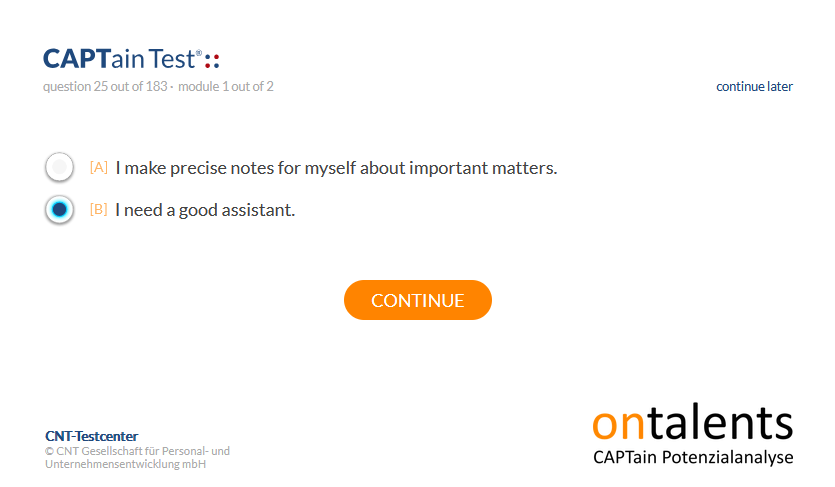
When taking the test, the first part of the questionnaire involves answering 183 paired comparison questions, which depict realistic decision-making situations and in which you must always select one answer. The aim is for you to answer intuitively. For most people, there will be one question where the decision is difficult. But don’t worry: thanks to the sophisticated algorithm behind the test, you can’t go wrong.
Example:
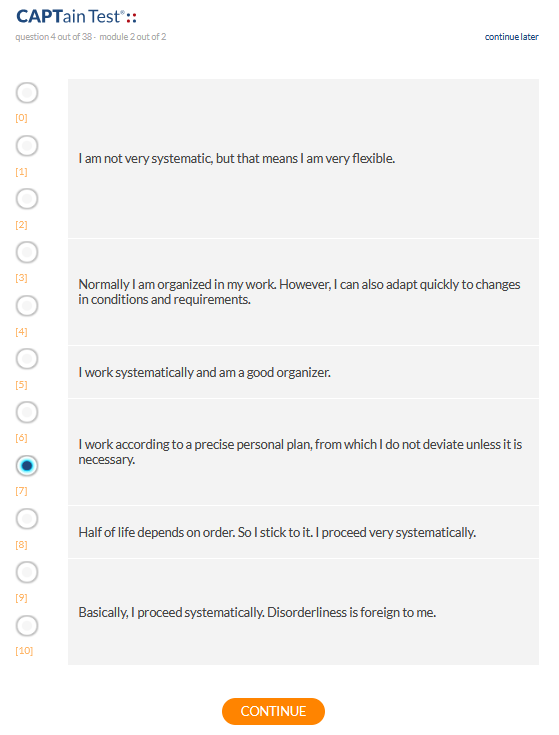
In the second part of the questionnaire, which you may be asked to complete, your self-assessment is assessed through 38 questions. Example:
The time taken to complete both questionnaires generally depends on your speed, averaging around 45 minutes.
As a general rule: all questions must be answered; it is not possible to go back or skip ahead without answering.
The time taken to complete both questionnaires generally depends on your speed, averaging around 45 minutes.
As a general rule: all questions must be answered; it is not possible to go back or skip ahead without answering.
Choose the statement that best describes you compared to the other one. Bear in mind that there is no right or wrong answer. Sometimes this decision isn’t entirely easy – that’s normal and exactly as it should be.
Neither statement describes you? Choose the one that contradicts your attitude and experience the least.
Do both statements apply to you? Choose the one that best suits you compared to the other.
In this highly unlikely event:
Please close your web browser and revisit the test link. Your progress will be saved so that you can continue from where you left off. If the problem persists, please feel free to contact the ontalents team, either by email at office@ontalents.com or by telephone on +43 1 405 24 00.
The protection of personal data is of particular importance to us. We therefore process your data exclusively in accordance with the relevant legal provisions (GDPR, TKG 2003). You are welcome to read more about this on our website under: Data Protection
The results are sent to the person who invited you to take the test. Depending on how the current process has been set up within the company, these will be shared with you and/or discussed with you in a face-to-face meeting.
The CAPTain Test® is a criteria-based assessment. It measures a person’s behaviour in the workplace and shows how this is perceived by others and can be observed.
With the CAPTain, you are not compared to other people.
As the test does not use any standard reference groups, no conclusions are drawn as to whether you are better or worse than others.
If the assessment is tailored to a specific role, it will simply highlight areas for improvement and provide information for staff development and training.
For further information about CAPTain, or if you have any technical queries, please contact ontalents on 01/405 24 00 or by email at office@ontalents.com. Our office hours are: Monday to Thursday, 9 am to 5 pm; Friday, 9 am to 2 pm.
General questions about CAPTain
CAPTain is a web-based personnel assessment tool that quickly, reliably and objectively describes a person’s working and performance style. To this end, self-reports on habits and experiences in everyday working life – collected using a specialised questioning technique (pair comparison method) – are analysed in accordance with principles of occupational psychology. The result is a profile that, across 38 dimensions, illustrates a person’s typical behaviour when dealing with practical tasks as well as with colleagues and staff.
CAPTain was developed as an online tool by occupational and organisational psychologists in accordance with recognised standards and modern theoretical principles. CAPTain has demonstrated its validity in numerous scientific studies.
CAPTain is subject to ongoing quality control and is regularly adapted to meet the changing requirements of workplace practice.
The CAPTain test system is based on the personality theory developed by Henry A. Murray. This theory posits that human behaviour is determined by two opposing forces:
1. ‘needs’: internal tensions, such as needs, aspirations, subjective desires and attitudes
2. ‘presses’: environmental demands placed on the individual
CAPTain measures the behavioural patterns that have emerged from the interplay between these two forces.
CAPTain is not a personality test, as it assesses behavioural tendencies
— that is, the way in which people act in a professional context. For example:
- Work and performance style
- Team and social behaviour
- Self-management
- Management and leadership skills
- Sales potential
- Learning and development potential
- Project management skills
- Alignment with the values and principles of agile working
CAPTain is used internationally in organisations of all sizes, as well as by consultancy firms. Alongside recruitment, staff development is the main area of application. Here, CAPTain is primarily used for identifying high-potential staff, analysing training needs and evaluating staff development measures. However, the method is also used in executive consultancy, coaching and team development.
The measurement theory model underpinning CAPTain is that of criteria-based assessment, the aim of which is to determine the test-taker’s position relative to the established criteria. This offers decisive advantages in aptitude assessment:
For a recruitment decision, for example, it is of little interest to know how independently a candidate works compared to their age and educational group (e.g. more independently than 60 percent of the comparison group), but rather whether the person demonstrates precisely the level of independence required for the specific role.
CAPTain is a scientifically validated method. Its use complies with DIN 33430. CAPTain meets all the quality criteria required of methods for assessing vocational aptitude.
We take data protection very seriously. Before you start the CAPTain assessment, you will have the option to access our privacy policy via a link on the welcome screen.
The quality standards of the CAPTain Test® comply with the quality standards set out in
DIN 33430:
Quality standards in vocational aptitude assessment
- Handbook
- Objectivity
- Reliability
- Validity
- Inviolability
- Economy (cost-benefit)
- Usefulness (relevance)
- Fairness
- Reasonableness
With an approval rate of over 90 percent, the CAPTain Test® is a hit not only with respondents, but also with decision-makers, HR professionals and coaches.
Although the idea of receiving a web-based performance appraisal and the specific ‘pair comparison’ question format may seem unfamiliar at first, employees and managers are regularly surprised by the quality of the insights provided by CAPTain.
Employees assessed by CAPTain agree more with this assessment than with their own self-description. Supervisors report that CAPTain helps them get to know their employees much better, which benefits everyone involved.
“I’m absolutely amazed at how these questions can produce such an accurate, comprehensive result.”
“I was still sceptical whilst answering the questions, but I agree with 99 percent of the report.”
“Unbelievable.”
“Thank you very much for this feedback; CAPTain has helped me recognise my blind spots for the first time.”
“Thank you for this opportunity; I now know what to look out for when managing my staff.”
“CAPTain doesn’t lie.”
Selecting the correct version of the CAPTain questionnaire
Please note that selecting the correct version of the CAPTain questionnaire is essential for obtaining a valid result!
Unfortunately, a common mistake is to select the version based on the intended target role. However, the target role is defined exclusively by the relevant requirements profile, whether this is explicitly documented or merely implied.
The key factor in selecting the correct version is the role a person currently holds!
Explanation: The questions available in all CAPTain questionnaires are identical and differ only in the specific wording relating to the relevant social context of a role. For example:
- Management: “My staff usually listen to my opinion”
- Specialist staff: “My colleagues usually listen to my opinion”
- Consulting/Sales: “My customers usually listen to my opinion”
- University students: “My fellow students usually listen to my opinion”
- School pupils: “My classmates usually listen to my opinion”
Choosing the correct version has the advantage that the person can put themselves in the situation described by the questions as effectively as possible.
Of course, valid assessments of a person’s leadership potential can also be made if they have completed the CAPTain questionnaire, for example, in the specialist staff version.
The CAPTain questionnaire consists of 183 paired comparison questions. Some versions of the CAPTain also include 38 self-assessment questions.
The time taken to complete both questionnaires generally depends on your speed, but on average it takes around 45 minutes.
Please get in touch with ontalents directly to discuss this and clarify any issues. Together, we’ll find the right solution for you and your requirements.
With CAPTain, a higher score does not necessarily mean a better result. How each trait should be assessed always depends on the requirements of the specific role.
For further information about CAPTain, or if you have any technical queries, please contact ontalents on 01/405 24 00 or by email at office@ontalents.com. Our office hours are: Monday to Thursday, 9 am to 5 pm; Friday, 9 am to 2 pm.
Questions about how the test is conducted
CAPTain is a web-based personnel assessment tool that quickly, reliably and objectively describes a person’s working and performance style. To this end, self-reports on habits and experiences in everyday working life – collected using a specialised questioning technique (pair comparison method) – are analysed in accordance with principles of occupational psychology. The result is a profile that, across 38 dimensions, illustrates a person’s typical behaviour when dealing with practical tasks as well as with colleagues and staff.
CAPTain was developed as an online tool by occupational and organisational psychologists in accordance with recognised standards and modern theoretical principles. CAPTain has demonstrated its validity in numerous scientific studies.
CAPTain is subject to ongoing quality control and is regularly adapted to meet the changing requirements of workplace practice.
To take any of the ontalents tests, open your preferred web browser, go to https://user.cnt-testcenter.com and enter your access code, or use the direct link, which will take you straight to your CAPTain test without needing to enter an access code.
To ensure you can use the website’s content successfully, we recommend that you grant permission when prompted about cookies or select ‘Allow session cookies’ in your browser settings.
The language is selected by ontalents when the test is created. Therefore, please do not use external translation tools, such as Google Translate, as double translation may result in illogical sentence structure. If you wish to change the language of the test, please contact the organisation that sent you your access codes.
“I’m absolutely amazed at how these questions can produce such an accurate, comprehensive result.”
“I was still sceptical whilst answering the questions, but I agree with 99 percent of the report.”
“Unbelievable.”
“Thank you very much for this feedback; CAPTain has helped me recognise my blind spots for the first time.”
“Thank you for this opportunity; I now know what to look out for when managing my staff.”
“CAPTain doesn’t lie.”
Paired comparison questions are questions where you have to choose between two statements. In the CAPTain test, these are statements relating to different behaviours, preferences and experiences in a work context.
No, thanks to the sophisticated algorithm behind the first questionnaire, you cannot go wrong with the paired comparison questions.
When you complete the second questionnaire – the self-assessment – you will know exactly which answer fits best.
The time taken to complete both questionnaires generally depends on your speed, but on average it takes around 45 minutes.
Yes, you can pause the CAPTain Test® at any time and pick up where you left off. However, we recommend that you complete the questionnaire as quickly as possible.
Depending on the desired assessment, the CAPTain Test® consists of one or two parts:
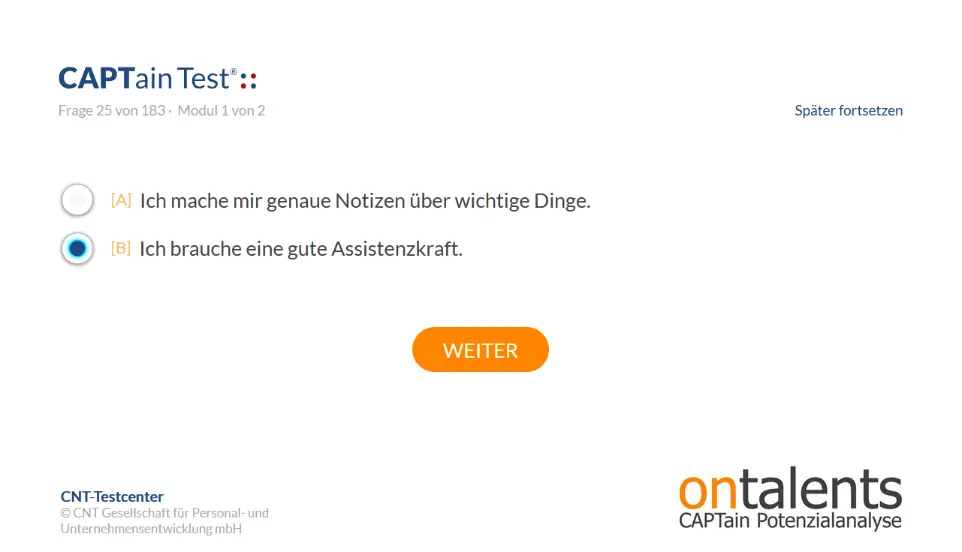
When taking the test, the first part of the questionnaire involves answering 183 paired comparison questions, which depict realistic decision-making situations and in which you must always select one answer. The aim is for you to answer intuitively. For most people, there will be one question where the decision is difficult. But don’t worry: thanks to the sophisticated algorithm behind the test, you can’t go wrong.
Example:
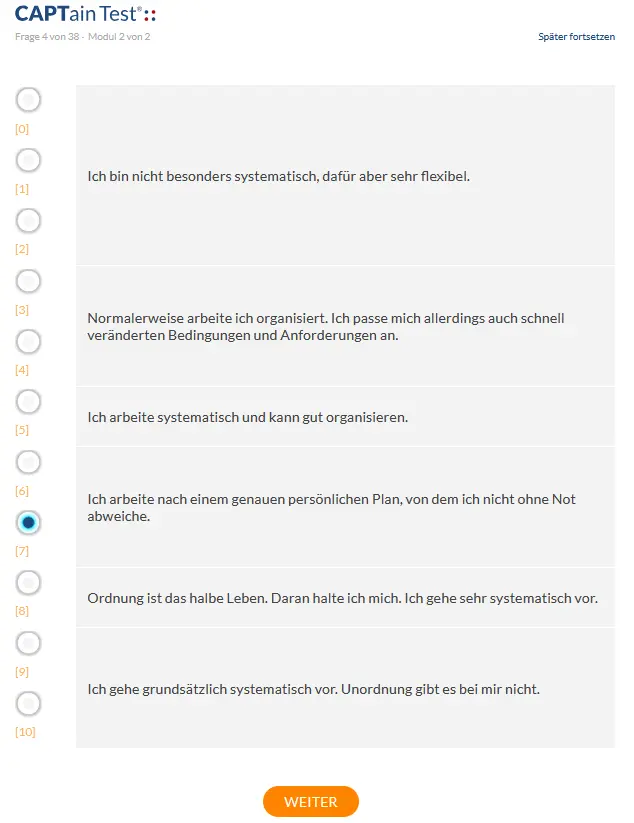
In the second part of the questionnaire, which you may be asked to complete, your self-assessment is assessed through 38 questions. Example:
The time taken to complete both questionnaires generally depends on your speed, averaging around 45 minutes.
As a general rule: all questions must be answered; it is not possible to go back or skip ahead without answering.
The time taken to complete both questionnaires generally depends on your speed, averaging around 45 minutes.
As a general rule: all questions must be answered; it is not possible to go back or skip ahead without answering.
Choose the statement that best describes you compared to the other one. Bear in mind that there is no right or wrong answer. Sometimes this decision isn’t entirely easy – that’s normal and exactly as it should be.
Neither statement describes you? Choose the one that contradicts your attitude and experience the least.
Do both statements apply to you? Choose the one that best suits you compared to the other.
In this highly unlikely event:
Please close your web browser and revisit the test link. Your progress will be saved so that you can continue from where you left off. If the problem persists, please feel free to contact the ontalents team, either by email at office@ontalents.com or by telephone on +43 1 405 24 00.
The protection of personal data is of particular importance to us. We therefore process your data exclusively in accordance with the relevant legal provisions (GDPR, TKG 2003). You are welcome to read more about this on our website under: Data Protection
The results are sent to the person who invited you to take the test. Depending on how the current process has been set up within the company, these will be shared with you and/or discussed with you in a face-to-face meeting.
The CAPTain Test® is a criteria-based assessment. It measures a person’s behaviour in the workplace and shows how this is perceived by others and can be observed.
With the CAPTain, you are not compared to other people.
As the test does not use any standard reference groups, no conclusions are drawn as to whether you are better or worse than others.
If the assessment is tailored to a specific role, it will simply highlight areas for improvement and provide information for staff development and training.
For further information about CAPTain, or if you have any technical queries, please contact ontalents on 01/405 24 00 or by email at office@ontalents.com. Our office hours are: Monday to Thursday, 9 am to 5 pm; Friday, 9 am to 2 pm.